
UK licensed lottery sites: Remote Lottery Operating Licence and Domain Scores
UK lottery sites operate under a distinct licensing regime that separates National Lottery operations, society lotteries run for charitable purposes, and commercial remote lottery products. Saferwager indexes UKGC licence data and Domain Scores for licensed lottery operations, revealing the structural differences that set this category apart from casino or betting sites.
Filter by Site Type
Lottery Sites List
Angling Trust
Active
Oxfam GB
Active
BHF Lottery
Active
Lincs & Notts Air Ambulance
Active
St Peter's Hospice Lottery
Active
Your Hospice Lottery
Active
Ardgowan Hospice Lottery
Active
SCAA
Active
Your Charity Lottery
Active
Ehaat Casino
Active
Loros
Active
LottoGo
Active
Saint Michael's Hospice Lottery
Active
Severn Hospice
Active
TCLottery
Active
ActionAid UK
Active
Bee-Ethical Limited
Active
Blaby Lottery
Active
Make A Smile Lottery
Active
Great Western Air Ambulance Charity Lottery
Active
Hospice Lottery Partnership
Active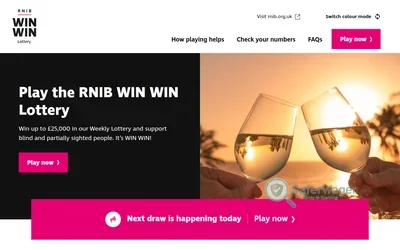
RNIB WIN WIN Lottery
Active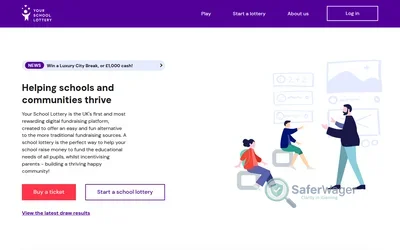
Your School Lottery
Active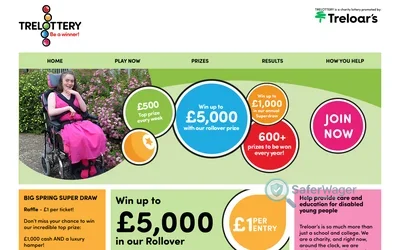
Trelottery
ActiveHow UK lottery licensing is structured under the Gambling Act 2005
The term 'lottery' covers more than one legal category in UK gambling law. The Gambling Act 2005 distinguishes between the National Lottery, society lotteries run for charitable or other good causes, and commercial lottery products. Each sits under a different regulatory framework, and not all of them are licensed by the UKGC in the same way.
The National Lottery operates under a dedicated statutory framework. It's regulated by the Gambling Commission, but its operating licence is issued to a single operator under a competitive tender run by the government, not through the standard operating licence application process that commercial operators use. That's a material distinction that the UKGC licence register doesn't make obvious at a glance.
Remote Lottery Operating Licence: what it covers
Commercial remote lottery products, meaning online draw-based lotteries and instant win games not run as society lotteries, require a Remote Lottery Operating Licence from the UKGC. This is a distinct licence type from the Remote Casino Operating Licence. It covers operators running online draws, virtual scratch cards, and instant win lotteries as commercial products.
Operators holding a Remote Lottery Operating Licence are bound by LCCP conditions covering player interaction, social responsibility, and technical standards, in the same way as remote casino licensees. But the product category they're authorised to offer is narrowly defined. An operator wanting to offer both lottery and casino products needs separate authorisation for each.
Society lotteries: a separate legal framework
Society lotteries are lotteries run by non-commercial societies, typically charities, sports clubs, or community organisations, to raise money for their stated purpose. They're licensed by the Gambling Commission but under a different process from commercial operators. Small society lotteries can register with a licensing authority rather than applying directly to the UKGC, depending on turnover thresholds.
The key regulatory requirements for society lotteries specify that a stated minimum proportion of proceeds must go to the society's purpose. The Gambling Act 2005 sets out these requirements, and the Gambling Commission has published guidance on the rules that apply at different turnover levels. Charitable raffles, prize draws, and fundraising lotteries all fall within this framework where they meet the legal definition of a lottery.
Important distinction: Society lotteries run for charitable purposes aren't the same as commercial lottery products. Their regulatory obligations, prize structures, and permitted ticket prices differ from commercial remote lottery operations. When Saferwager lists UK lottery sites, the relevant licence type tells you which framework applies: a Remote Lottery Operating Licence indicates a commercial operator, while a society lottery licence indicates a charitable or non-commercial operation.
Society lottery rules: draw prices, prize caps, and proceeds requirements
Society lotteries operate under specific rules that commercial lottery products don't face. These rules govern how tickets can be priced, what the maximum prize can be, and what proportion of proceeds must go to the society's stated purpose. They exist because society lotteries benefit from a lighter regulatory framework in exchange for serving a non-commercial purpose.
These restrictions aren't just technical compliance details. They define whether a lottery is legitimately operating as a society lottery or whether its structure has drifted into something that should be regulated as a commercial operation instead.
Ticket price and draw frequency limits
For large society lotteries (those registering directly with the UKGC rather than with a local licensing authority), permitted ticket prices and draw frequencies are set by regulation. Individual ticket prices are capped. There are limits on how frequently draws can take place. These constraints don't apply to commercial remote lottery operators, whose product design is shaped instead by their LCCP technical standards and social responsibility conditions.
The Gambling Commission has periodically reviewed society lottery thresholds. Changes to permitted prize limits and turnover thresholds have been implemented in recent years, reflecting pressure from the charitable sector to allow larger-scale fundraising operations.
Minimum proceeds requirements and how they're calculated
A society lottery must apply a minimum proportion of proceeds to its stated purpose. The exact percentage is set by regulation and has varied over time, but the principle is consistent: the lottery exists to raise money for a specific cause, and the rules are designed to ensure that cause actually receives a meaningful share of what players spend.
Operators of society lotteries must maintain records showing how proceeds are allocated. The UKGC can require these records as part of licensing or compliance monitoring. Where a society lottery's accounts show that proceeds to the cause are falling below the minimum requirement, that's a compliance issue under licence conditions.
Instant win and raffle products under lottery licensing
- Draw-based lottery
- Tickets are sold before a draw that determines winners. The pool of players buying tickets before the draw date determines the prize pool structure for that draw.
- Instant win game
- Outcome is determined at the point of purchase. Permitted under both commercial remote lottery licences and some society lottery formats. Subject to LCCP Technical Standards on random outcome determination.
- Raffle
- A type of lottery where a fixed number of tickets are sold and prizes are allocated by draw. Can be run as a society lottery for charitable purposes or as a commercial product under a remote lottery licence depending on structure and operator.
- Prize cap
- A maximum prize amount applicable to society lotteries under the Gambling Act 2005. Commercial remote lottery operators aren't subject to the same cap, though they may set their own maximum prize structures as commercial decisions.
How lottery sites compare to casino and betting operations in Domain Score data
Lottery sites, and particularly society lottery operations, tend to look different from commercial gambling operators when assessed through Domain Score data. The reasons are structural rather than indicative of lower quality. They reflect the different organisational types running lottery operations compared with those running casino or sports betting products.
Many society lotteries are run by charities and third-sector organisations that don't have dedicated digital infrastructure teams. Their domains may be well-established (some major charity lotteries have been operating online for many years) but the technical configuration of those domains sometimes reflects a different level of infrastructure management than a commercial gambling operator would apply.
Domain age and registration patterns in the lottery sector
Large charity lotteries run by established organisations, such as hospice lotteries or cause-specific charity raffles, often have domains with long registration histories. The charity itself may have been operating online long before the lottery product was added to its site. That domain age translates into strong age component scores.
Smaller society lotteries run by sports clubs or community organisations can have the opposite pattern: newer domains, sometimes registered by volunteers rather than through a corporate registrar, with less consistent WHOIS information. These sites may be entirely compliant with their licence conditions while scoring lower on technical Domain Score components.
SSL configuration and hosting infrastructure for charity operators
Commercial gambling operators typically manage their own or dedicated managed hosting with professionally maintained SSL certificates. Charity lottery sites more often run on shared hosting platforms or website builders where SSL configuration is automated rather than actively managed. This can produce lower SSL grades in Domain Score data where certificate management is less precise, even when the operator is fully UKGC-licensed and compliant with its licence conditions.
It's a distinction worth holding in mind. A lower Domain Score for a charity lottery site doesn't necessarily indicate regulatory concern. It may reflect the technical infrastructure reality of a charitable organisation that isn't primarily a digital business.
WHOIS transparency differences between commercial and society lottery operators
| Operator type | Typical WHOIS pattern | Domain Score implication |
|---|---|---|
| Commercial remote lottery operator | Corporate registrant, professional DNS management, consistent contact records | Generally scores well on transparency and DNS components |
| Major charity lottery (e.g. hospice, national charity) | Registered charity as domain owner, established history, usually professionally managed | Strong domain age, variable SSL and DNS configuration depending on hosting |
| Small society lottery (club, community group) | Individual or volunteer contact, newer registration, less consistent records | Lower age and WHOIS transparency scores, not correlated with compliance quality |
Reading lottery licence data in Saferwager's records
The UKGC's licence register lists all active lottery operating licences. But the register doesn't distinguish between a National Lottery operator (which operates under a separate statutory framework), a large commercial remote lottery business, and a small society lottery run for a local cause. The licence category alone doesn't tell you which type you're looking at.
Saferwager's site listings for the lottery category pull from UKGC licence data and cross-reference it against domain records and operator profiles. The licence type displayed on each operator profile reflects what the register shows. Where a site is listed as a lottery operation, the operator's profile links to the underlying licence record and any enforcement history associated with that operator.
How Trust Scores apply to lottery operators
Trust Scores are calculated for all UKGC-licensed operators in the database, including lottery operators. The six scoring components (enforcement, corporate, licence, technical, longevity, and transparency) apply in the same way as they do for casino or betting operators. But some components will read differently for lottery operators by nature.
The Technical sub-score, which draws on Domain Scores from associated sites, may be lower for charity lottery operators for the infrastructure reasons described above. That doesn't mean those operators have worse compliance records. It means Saferwager's scoring reflects genuine technical differences in how different operator types configure their online presence.
Enforcement history in the lottery sector
UKGC enforcement against lottery operators is less frequent than against casino or sports betting operators. That partly reflects the smaller number of licensed lottery operations. But it also reflects that the types of failures driving enforcement in casino (AML systemic failures, social responsibility programme deficiencies at scale) are less common in lottery operations where the product format creates different consumer risk patterns.
Society lottery enforcement tends to focus on proceeds-to-purpose compliance, ticket pricing rules, and prize cap adherence rather than on the anti-money laundering and safer gambling conditions that dominate casino enforcement cases.
What the absence of enforcement history means for lottery operators
An operator with no indexed enforcement history hasn't necessarily been scrutinised and cleared. The UKGC doesn't publish enforcement decisions for every review it conducts. A clean enforcement record on Saferwager means no indexed public enforcement actions, not a confirmed clean regulatory history.
- Check the operator's licence type to understand which regulatory framework applies.
- Review the operator's linked company profile for corporate structure and director records where available.
- Note whether the operator is running as a society lottery or a commercial remote lottery product, as their proceeds obligations and prize rules differ.
- Use the Domain Score to assess the technical maturity of the site, understanding that lower scores for charity operators often reflect infrastructure realities rather than compliance concerns.