
UKGC FOI requests: what the Gambling Commission discloses and why it matters
The UK Gambling Commission is a public authority under the Freedom of Information Act 2000, obligated to respond to valid requests about its regulatory data, staffing, enforcement statistics, and internal correspondence. This page examines what gets requested, how the UKGC responds, what its exemption decisions reveal, and how Saferwager uses FOI disclosures in its analysis.
Filter by Source Type
FOI Disclosures List

UKGC Can't Track London Venue Growth
A Freedom of Information request has revealed the UK Gambling Commission does not hold historical data on the number of new gambling venues in Lond...

UKGC Hides Names of Firms in 'Special Measures'
The UK Gambling Commission has refused a Freedom of Information request to identify operators placed under 'special measures' for suspected failing...
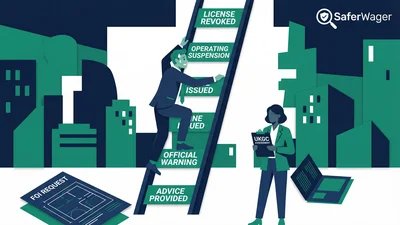
UKGC Data Reveals Operator Compliance Grading System
A Freedom of Information request has unveiled the internal framework the UK Gambling Commission uses for its compliance assessments. The data shows...

UKGC: No Data on Self-Exclusion Integration
A Freedom of Information request has revealed the UK Gambling Commission holds no information on whether the UK's separate land-based self-exclusio...

Lottery Prize Split: Retail vs Online Revealed
New data from the Gambling Commission reveals a near 50/50 split in National Lottery prize money between retail and online players for the year end...

UKGC Can't Track Crime Victim Payouts
The UK Gambling Commission has revealed it cannot track the total amount of money paid to victims of crime from operator fines. In response to a Fr...
UKGC Withholds Lottery Applicant Data
The UK Gambling Commission has refused a Freedom of Information request for intelligence reports on a former National Lottery licence applicant. Th...

UKGC's Staff Engagement Priorities Revealed
A recent Freedom of Information disclosure has revealed the specific criteria the UK Gambling Commission uses to measure and improve its own employ...

UKGC Withholds Status of Evolution AB Licence Review
The UK Gambling Commission has refused to disclose the status of its licence review into major games supplier Evolution AB. Citing law enforcement ...

UKGC Withholds 888/777 Investigation Data
The UK Gambling Commission has declined to confirm or deny if it holds information on non-public investigations into operator 888/777. In a Freedom...

UKGC Reveals Staff Engagement Tech Criteria
A Freedom of Information request has revealed the criteria the UK Gambling Commission used to procure a new employee engagement platform. The searc...

UKGC Withholds Spending Data Over £25k
The UK Gambling Commission has declined to release data on its transactions over £25,000, citing an exemption for information intended for future ...

Lottery Data Gaps Revealed in UKGC FOI Response
A Freedom of Information request has revealed that the UK Gambling Commission does not hold data on the end dates for National Lottery Scratchcards...

UKGC Withholds Recent Suicide Notification Data
The UK Gambling Commission has declined to release up-to-date figures on suicide notifications from operators, stating the data is intended for fut...

Lottery Sales Data a 'Trade Secret', Says UKGC
The UK Gambling Commission has refused to release detailed monthly sales data for the National Lottery, classifying the information as a 'trade sec...

UKGC Hides Donate Win Licence Details
The UK Gambling Commission has used a law enforcement exemption to refuse to confirm or deny whether prize draw operator Donate Win Ltd holds a gam...
UKGC Discloses Contract Framework Details
The UK Gambling Commission has released details about the procurement frameworks for six of its service contracts. The disclosure, made under the F...

UKGC Withholds Land-Based Breach Data
The UK Gambling Commission has declined a Freedom of Information request for details on compliance checks and potential rule breaches at land-based...

UKGC Data: Just Two New Casino Licences in 2023
A Freedom of Information disclosure from the Gambling Commission shows that only two new land-based casino operating licences were granted in 2023....
UKGC Withholds Data Science Project Details
The UK Gambling Commission has declined to release detailed documents about its new data science projects, which are central to its strategy for ma...

UKGC Data: Hundreds of Safer Gambling Checks
A Freedom of Information request reveals the UK Gambling Commission has conducted over 200 assessments on key safer gambling rules since 2022. Howe...

UKGC: No Data on EuroMillions Sales
A Freedom of Information request has revealed the UK Gambling Commission does not hold detailed sales data for EuroMillions tickets across all part...

UKGC Lacks Records on Key Digital Safety Advice
A Freedom of Information request has revealed the UK Gambling Commission did not implement key 2019 recommendations from its own digital advisory p...

UKGC: No Data on Harm Algorithm Marketing Links
A Freedom of Information request has revealed the UK Gambling Commission does not specifically record data on how operators' harm reduction algorit...
What types of information get requested from the UKGC
FOI requests to the Gambling Commission cluster around a predictable set of topics. That clustering is itself informative. It tells you which aspects of gambling regulation people find opaque, where official publications don't satisfy the demand for granular data, and where the UKGC's own published output leaves gaps that requesters try to fill through the FOI route.
The most frequent categories span staffing and resource levels, enforcement frequency and outcomes, licence processing times, complaint handling statistics, and the internal correspondence underlying specific regulatory decisions. These aren't peripheral questions. They go to the UKGC's operational capacity and the consistency of its regulatory approach.
Regulatory and enforcement data
Requests about enforcement data are among the most common. People want to know how many licence reviews the UKGC opens in a given period, how many result in formal action versus closure without finding, and how long the process takes. The UKGC publishes aggregate enforcement statistics but doesn't routinely break down outcomes by operator type, licence category, or review trigger.
FOI requests that target that granularity often receive partial responses. The UKGC may confirm aggregate figures while declining to provide operator-level breakdown under Section 43 (commercial interests) or Section 31 (law enforcement). Each exemption cited tells you something about what the UKGC holds and considers sensitive. A Section 31 refusal on a specific enforcement matter confirms the matter is under active regulatory consideration.
Staffing levels and internal resource allocation
Requests about UKGC staffing, case handling capacity, and compliance inspection frequency have produced some of the more analytically useful disclosures. The number of compliance case officers, the ratio of case officers to licensed operators, and turnover rates in compliance functions all bear on the UKGC's ability to deliver consistent oversight. These figures are rarely published proactively.
FOI responses on staffing are more likely to receive full or partial disclosure than requests about specific operator matters, because staffing data doesn't typically engage the commercial or law enforcement exemptions. Where the UKGC does withhold staffing information, it sometimes cites Section 36 (prejudice to effective conduct of public affairs), which is a different category of concern.
Licence processing and application data
Requests about licence application processing times, approval rates, and the criteria applied to specific application types have generated a body of disclosures that isn't easily available elsewhere. The UKGC publishes average timelines for licence types but doesn't routinely disclose how application assessments are conducted, how many applications receive enhanced scrutiny, or what triggers a more detailed review.
- Remote operating licence
- Required for operators providing gambling services to UK consumers remotely. FOI requests about the assessment criteria for these licences have produced partial disclosures about the due diligence framework the UKGC applies.
- Personal management licence
- Required for senior personnel in licensed gambling operations. Requests about the assessment and revocation of these licences have sometimes been refused under Section 40 (personal data) or Section 31.
- Premises licence
- Issued by local authorities under UKGC oversight for land-based gambling venues. FOI requests about premises licence compliance records are often directed to local authorities rather than the UKGC directly.
How the UKGC responds and what exemptions reveal
Understanding a FOI response requires reading the exemptions as carefully as the disclosed information. An exemption claim is a substantive statement. It tells you that the information exists, that the UKGC has considered it, and that the regulator has determined a specific statutory ground justifies non-disclosure. The choice of exemption is not arbitrary. It reflects a categorisation decision that carries analytical weight.
The Freedom of Information Act 2000 provides absolute exemptions, which apply automatically once the criteria are met, and qualified exemptions, where the UKGC must also conduct a public interest test. When the UKGC refuses a request under a qualified exemption, the public interest analysis it provides is worth reading carefully. It documents the UKGC's stated reasoning for protecting the information.
The most frequently cited exemptions in UKGC responses
| Exemption | Statutory basis | What it confirms about the information | Absolute or qualified? |
|---|---|---|---|
| Section 12 | Cost limit (exceeds £450 or 18 hours) | Information exists but isn't retrievable efficiently; often reveals how data is structured internally | Absolute |
| Section 31 | Law enforcement and regulatory activity | Information relates to ongoing enforcement; confirms active regulatory consideration | Qualified (public interest test required) |
| Section 40 | Personal data | Information relates to identifiable individuals; standard in requests about named personnel | Absolute (for third-party personal data) |
| Section 43 | Commercial interests | Release would harm commercial interests of the UKGC or a third party; common in operator-specific requests | Qualified (public interest test required) |
| Section 36 | Effective conduct of public affairs | Internal deliberations or policy-making; used to protect pre-decisional analysis and advice | Qualified (and requires Accountable Official's reasonable opinion) |
Reading negative disclosures analytically
A negative disclosure, where the UKGC confirms it doesn't hold the requested information, is one of the most informative response types. It maps the limits of the UKGC's data collection directly. If the UKGC confirms it doesn't hold complaint resolution rates broken down by individual operator, that's a structural fact about regulatory oversight, not a gap in record-keeping.
Negative disclosures deserve as much attention as refusals. Both tell you something about what the regulator can and can't answer. The difference is that a refusal confirms information exists and is protected, while a negative disclosure confirms it doesn't exist in the UKGC's records at all. Both are analytically useful, for different reasons.
The internal review and ICO appeal route
If a requester believes the UKGC has wrongly refused their request, they can ask for an internal review. The UKGC must complete an internal review within 20 working days. If the outcome remains unsatisfactory, the requester can complain to the Information Commissioner's Office (ICO), which has the power to issue a Decision Notice requiring the UKGC to disclose. ICO Decision Notices about UKGC responses are themselves public documents and occasionally useful sources for understanding what the ICO considers the UKGC should have released.
How to make a FOI request to the UKGC
Making a FOI request to the Gambling Commission isn't complicated, but the framing of the request directly affects the response you get. A poorly scoped request is more likely to attract a Section 12 cost-limit refusal. A well-scoped request, targeting specific records or data sets rather than broad categories, is more likely to produce a usable response.
The process is straightforward. Submit a written request by email or letter to the UKGC's FOI contact point. The request must describe the information sought in enough detail that the UKGC can locate it. You don't need to explain why you want the information or identify yourself as anything beyond a person making a valid request under the Act.
The 20 working day response timeline
The Freedom of Information Act 2000 requires public authorities to respond within 20 working days of receiving a valid request. For the UKGC, that clock starts when the request is received and confirmed as valid. If the UKGC needs to clarify the scope of the request, the clock may pause while it waits for clarification. Responses to complex requests can take the full 20 days.
If the UKGC fails to respond within 20 working days, the requester can complain directly to the ICO. Routine delays are common with heavily resourced public authorities handling high volumes of FOI requests. They don't constitute a refusal but they can be reported as non-compliance. The UKGC publishes response time statistics that show its compliance with statutory timelines.
What makes a request well-scoped
Broad requests like 'all correspondence about operator X' are likely to attract either a Section 12 cost-limit refusal or a large partial disclosure with extensive redaction. Narrowly scoped requests that target specific document types, date ranges, or data fields are more likely to receive usable responses within the cost threshold.
- Specify the document type: Ask for correspondence, statistics, internal guidance, or a specific report rather than 'all information about' a topic. The UKGC holds different record types in different systems.
- Set a date range: Open-ended time ranges are a common cause of Section 12 refusals. A specific financial year or calendar year usually keeps the search within scope.
- Reference the specific concern: If the request relates to a specific licence category, LCCP condition, or regulatory process, name it. The UKGC's records are organised around those structures.
- Ask separately: Multiple unrelated questions in one request can be refused or fragmented. Separate requests for distinct topics are usually more effective.
Practical note: The UKGC is a public authority under both the Freedom of Information Act 2000 and the Environmental Information Regulations 2004 (EIR). If the information you're seeking relates to environmental matters affecting gambling venues or estates, the EIR may apply instead of FOIA, with slightly different exemption structures and response obligations. Most gambling regulatory data falls under FOIA rather than EIR.
How Saferwager uses FOI responses in its regulatory analysis
FOI responses aren't supplementary material in Saferwager's analysis. They're primary sources that inform operator scores, verify official statistics, and document data gaps that affect how the UKGC's published output should be read. The articles indexed under the FOI section treat each response as a document to be analysed, not summarised.
The analytical process works in both directions. FOI requests can confirm data the UKGC has published elsewhere, which matters when there's a discrepancy between a published statistic and what the UKGC holds internally. They can also surface information the UKGC wouldn't proactively release, which is the classic use case. Both directions are analytically useful.
Mapping data gaps across the regulatory record
One of the most consistent outputs from FOI analysis is a map of what the UKGC doesn't hold at the granularity requesters want. That map is informative. Operator-level complaint resolution rates, audit records for specific game mechanics, and historical enforcement correspondence from earlier periods all fall into this category.
When Saferwager identifies a recurring data gap, it documents it in the relevant articles so the pattern is visible. A single negative disclosure might reflect a one-off data organisation issue. A pattern of negative disclosures across multiple requests on a specific topic tells you something structural about how the UKGC collects and retains information.
Verifying official statistics against FOI disclosures
Discrepancies between UKGC published statistics and FOI responses are rare but not unknown. When a published figure can't be reconciled with data revealed through FOI, that's analytically significant. It either means the published figure is drawn from a different data set than the FOI response, that the reporting methodology changed between periods, or that there's an inconsistency in the UKGC's own records.
Saferwager's articles document specific instances where FOI disclosures and published statistics diverge, without speculating about cause. The divergence itself is the fact worth recording. It tells you the published figure should be read with an awareness that an alternative measurement exists in the UKGC's own records.
Connecting FOI findings to operator Trust Scores
When a FOI response concerns a named operator, the article analysing that response links to the operator's profile page. The Transparency sub-score within the Trust Score reflects signals about how open an operator's public record is. FOI disclosures about an operator's regulatory correspondence feed into that signal, not as a mechanical input but as a contextual factor that analysts consider when assessing the score.
Operators who appear in FOI disclosures about licence reviews, AML concerns, or complaint handling aren't automatically penalised in their Trust Scores. The analytical question is what the disclosure reveals about the operator's regulatory standing, and whether that revelation is consistent with or diverges from other signals already in the scoring data. The articles here provide that interpretive layer.