
UKGC Withholds Key Complaint & Harm Data
Regulator cites excessive cost in response to a request for five years of operator complaint statistics and social responsibility funding.
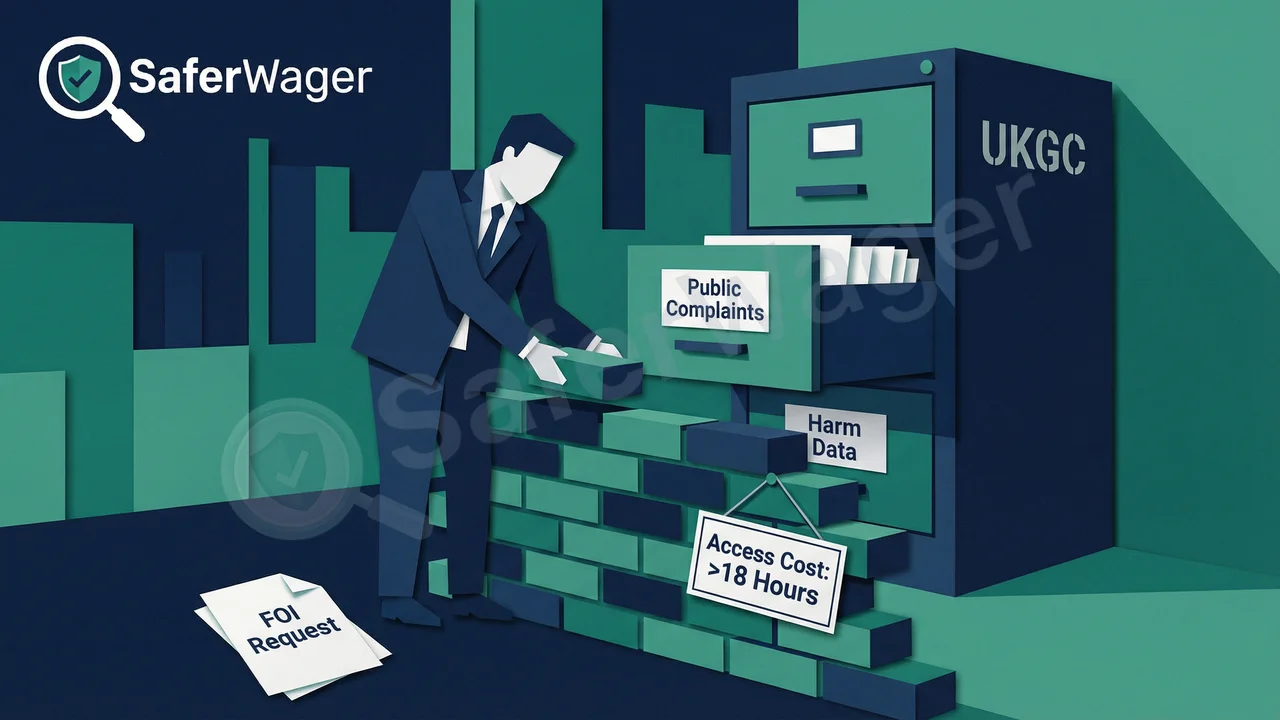
The UK Gambling Commission has withheld five years of data on public complaints, social responsibility breaches, and operator funding for harm reduction, stating it would be too costly to compile. The refusal highlights a lack of readily accessible information on key consumer protection metrics.
Article Content
The UK Gambling Commission (UKGC) has declined to release five years of comprehensive data on public complaints against operators, citing the cost of compiling the information as excessive.
The decision came in response to a Freedom of Information (FOI) request dated 6 December 2023, which sought crucial statistics on the performance of the UK's licensed gambling industry in relation to consumer protection.
What Information Was Withheld?
The request asked for a detailed, five-year breakdown of several key metrics, including:
- The total number of complaints received from the public about gambling operators.
- How many of these complaints were resolved in favour of the consumer.
- The number of complaints specifically related to breaches of the Social Responsibility Code (part of the LCCP).
- Data on inquiries regarding refunds for problem gamblers.
- The amount of money contributed by the top 10 UK operators to organisations tackling gambling-related harm.
This data is vital for consumers seeking to understand an operator's track record and the effectiveness of the regulatory framework in protecting players. Information on social responsibility breaches and contributions to harm reduction charities provides insight into an operator's commitment to safer gambling beyond its legal obligations.
The UKGC's Justification
In its response, the Gambling Commission stated that it would not provide the information, invoking Section 12 of the Freedom of Information Act 2000. This section allows public authorities to refuse requests where the cost of compliance would exceed the 'appropriate limit' of £450, which is estimated to be 18 hours of staff time.
The regulator explained that the requested information is not held in a single, central location. It estimated that the process to "identify, locate, retrieve and extract" the data across its various systems would take longer than the 18-hour limit.
The Commission advised the requester that they could submit a more refined, narrower request, which would be treated as a new inquiry.
Significance for Consumers
The refusal to provide this data highlights a significant transparency gap. The fact that the regulator itself cannot easily compile fundamental statistics on complaints, social responsibility failures, and industry funding for harm prevention raises questions about its data management and oversight capabilities.
For consumers, this lack of accessible, centralised data makes it difficult to assess the overall performance of the industry and the effectiveness of the complaints process. Without a clear public record of these key metrics, it is challenging to hold both operators and the regulator accountable for upholding safer gambling standards.