
UKGC Withholds Data on Bonus Rule Enforcement
Regulator cites excessive cost to retrieve information on compliance checks for rewards and VIP schemes, leaving enforcement levels unclear.
The UK Gambling Commission has refused to release data on its enforcement of rules governing customer bonuses and rewards. Citing excessive costs, the regulator withheld information on the number of compliance checks and breaches found since June 2022, limiting transparency on a key area of consumer protection.
Article Content
UKGC Cites Excessive Cost in Refusal to Release Bonus Compliance Data
The UK Gambling Commission (UKGC) has withheld information about its enforcement of rules governing customer bonuses and rewards, citing the cost of retrieving the data would exceed the legal limit for a Freedom of Information (FOI) request.
The request, dated 16 July 2025, sought to understand the frequency and outcomes of the regulator's compliance assessments on a key area of consumer protection. The refusal leaves consumers and industry observers in the dark about how rigorously these rules are being policed.
What Information Was Requested?
The FOI request asked for specific data on the UKGC's compliance activities since 1 June 2022. It focused on two provisions of the Licence Conditions and Codes of Practice (LCCP):
- LCCP 5.1.1 (Rewards and bonuses): This provision ensures that any incentives are constructed and offered in a socially responsible manner and are not misleading.
- LCCP 5.1.2 (Proportionate rewards): This rule requires operators to ensure rewards are proportionate to the customer's spending and play.
The request also sought to find out how many of these assessments included checks on operator's adherence to the 'High Value Customers' guidance, how many involved investigations into gambling algorithms, and a detailed breakdown of specific rule breaches.
Why the Data Matters
These LCCP provisions are critical for consumer protection. They are designed to prevent operators from using bonuses and VIP schemes to encourage excessive or harmful gambling. Data on the UKGC's enforcement activities provides a crucial measure of the regulator's effectiveness and helps identify trends in operator compliance. Without this information, it is difficult to assess whether the rules are having their intended effect.
The request for information on algorithm investigations is also significant, as these complex systems determine the gambling experience for millions of online customers. Transparency around their oversight is a key consumer concern.
The UKGC's Response
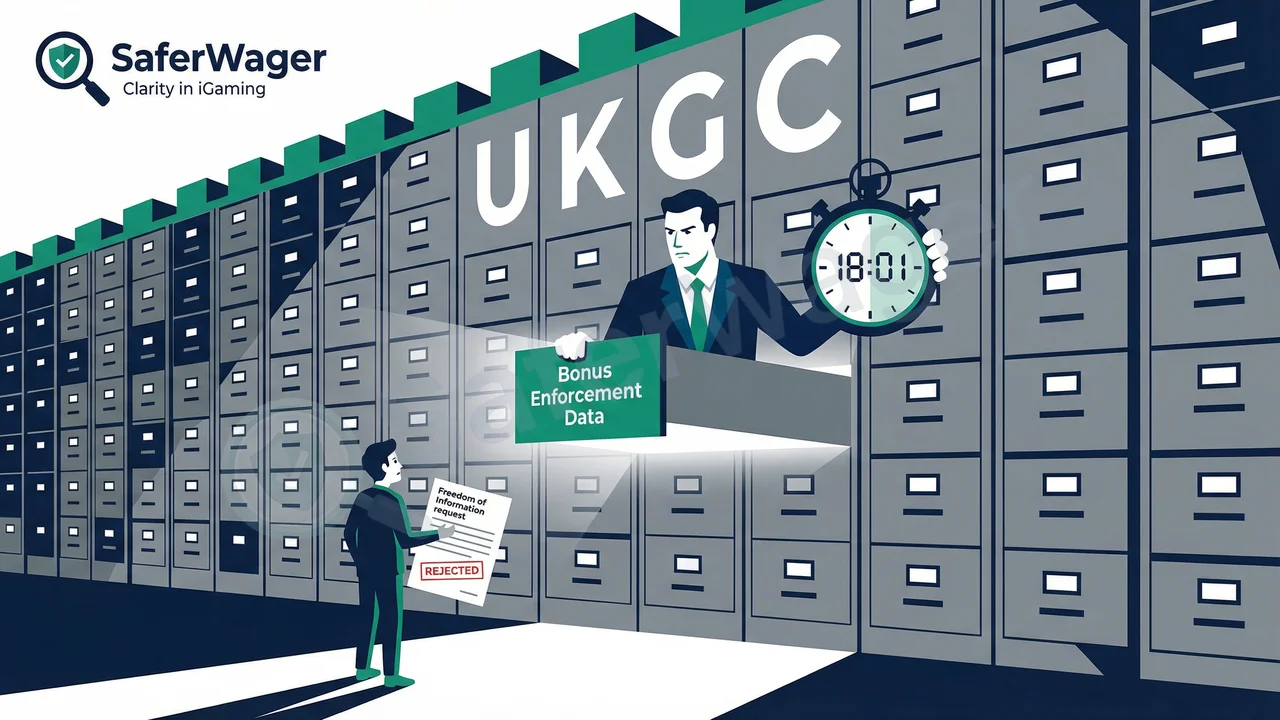
The Gambling Commission refused the request entirely, invoking Section 12 of the Freedom of Information Act. This section allows public bodies to deny requests where the cost of fulfilling them would exceed £450, which is estimated to be 18 hours of staff time.
In its response, the UKGC stated that an initial search returned a "large number of records." It claimed that reviewing these documents to identify and extract the relevant information would take "in excess of 18 hours."
As a result, no data was provided. The regulator noted that the requestor could submit a more refined, narrower request, which would be treated as a new enquiry.
Significance for Consumers
The refusal to provide data on enforcement actions for bonuses and rewards raises questions about regulatory transparency. While the UKGC is legally entitled to refuse requests on the grounds of cost, the inability to retrieve fundamental performance data on its own compliance activities is noteworthy.
For consumers, this lack of transparency means there is no public data to verify how often the regulator is checking for unfair or irresponsible bonus offers. It obscures the level of scrutiny being applied to VIP schemes and the algorithms that power online gambling products, both of which are central to modern consumer protection efforts.