
UKGC Historical Enforcement Data 'Inaccessible'
Regulator cites cost and time limits in refusing to provide a complete record of enforcement actions older than three years.
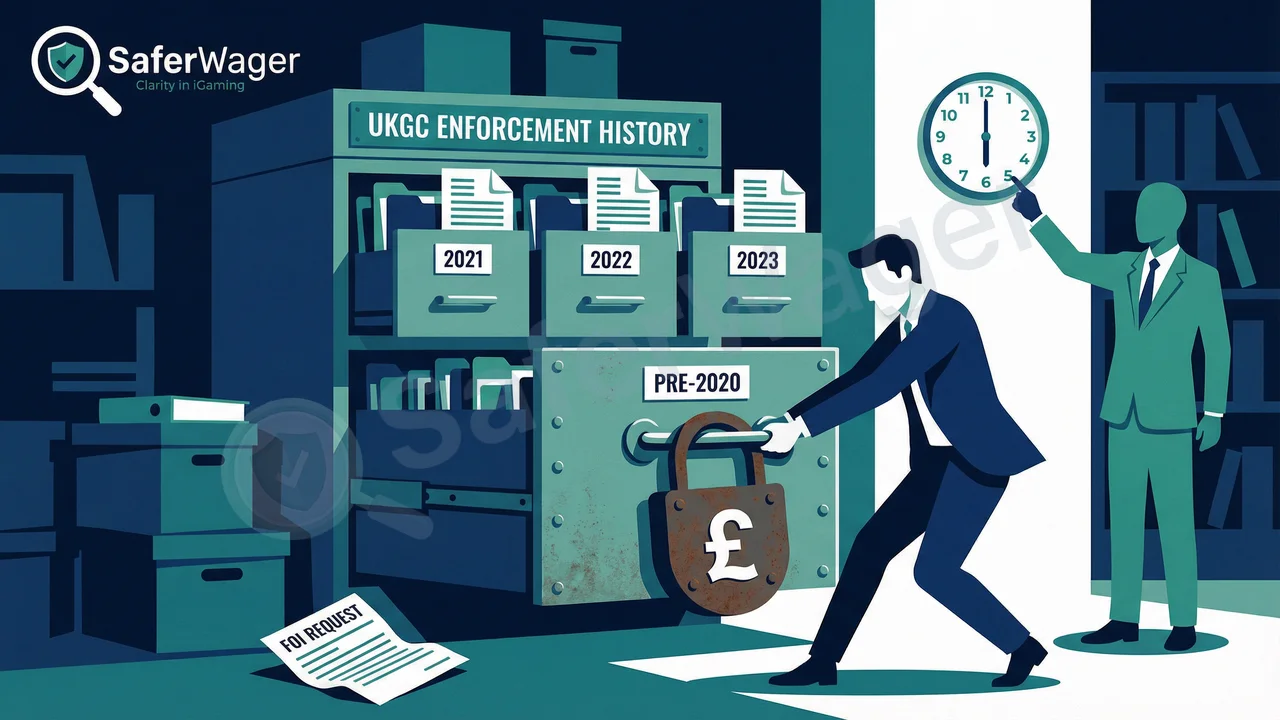
A Freedom of Information request has revealed the UK Gambling Commission cannot easily retrieve its own enforcement action records from before May 2020. The regulator cited excessive cost and time, indicating a lack of a central, searchable archive for historical sanctions.
Article Content
Regulator Cites Cost in Refusal to Share Historical Sanctions Data
A Freedom of Information (FOI) request has revealed that the UK Gambling Commission (UKGC) cannot easily access and provide a complete public record of its own historical enforcement actions.
In a response dated 23 September 2023, the regulator stated that retrieving public statements on enforcement actions from before 27 May 2020 would exceed the cost and time limits permitted under UK law. This effectively makes a comprehensive, long-term history of operator sanctions difficult for the public to obtain.
Why This Matters for Consumers
Public statements on enforcement action are a crucial tool for consumers. They detail when a gambling operator has breached its licence conditions, often relating to social responsibility and anti-money laundering failures. This information allows players to assess an operator's track record and make informed decisions about where to gamble.
The inability to easily access records older than a few years creates an information gap, preventing a full, long-term view of an operator's compliance history. While recent actions are available on the UKGC's website, this response indicates that a complete historical archive is not readily searchable or centrally located.
Details of the FOI Request
The request asked for all public statements on enforcement action issued on or before 27 May 2020. The UKGC confirmed it holds the information but refused to provide it, citing Section 12 of the Freedom of Information Act 2000.
This section allows public authorities to refuse requests where the cost of fulfilling them would exceed £450, which is estimated to be the equivalent of 18 hours of staff time. The Commission explained its reasoning:
"This information is not stored in a central location and includes in excess of 15 years worth of records, which would need to be reviewed... We estimate that it would take in excess of 18 hours to determine appropriate material and locate, retrieve and extract any relevant information."
The UKGC suggested that a refined request with a narrower time scale might be possible to fulfil within the statutory limits.
Significance for Regulatory Transparency
The response highlights a significant challenge in accessing long-term regulatory data. If the Commission itself finds it too resource-intensive to collate its own historical enforcement publications, it raises questions about the overall accessibility of this public interest information.
For consumers, researchers, and journalists, this means that analysing long-term trends in operator compliance or the effectiveness of regulatory sanctions is significantly hampered. The practical outcome is that an operator's regulatory history effectively has a rolling window of visibility, with older sanctions becoming obscured by data retrieval challenges.