
UKGC Hides Donate Win Licence Details
Regulator uses law enforcement exemption to avoid confirming or denying information about prize draw operator Donate Win Ltd.
The UK Gambling Commission has used a law enforcement exemption to refuse to confirm or deny whether prize draw operator Donate Win Ltd holds a gambling licence. The response highlights the regulatory grey area of prize competitions and signals to consumers to exercise caution.
Article Content
UKGC Cites Law Enforcement Exemption in Response to Query on Donate Win Ltd
The UK Gambling Commission (UKGC) has refused to confirm or deny whether prize draw operator Donate Win Ltd holds, or has ever applied for, a gambling licence. In a response to a Freedom of Information (FOI) request dated 5 September 2025, the regulator cited a law enforcement exemption to withhold the information.
The original request sought to clarify the legal and regulatory status of the company and its activities, which are described as selling tickets for charity raffles with high-value prizes like cars and smartphones.
What the Response Reveals
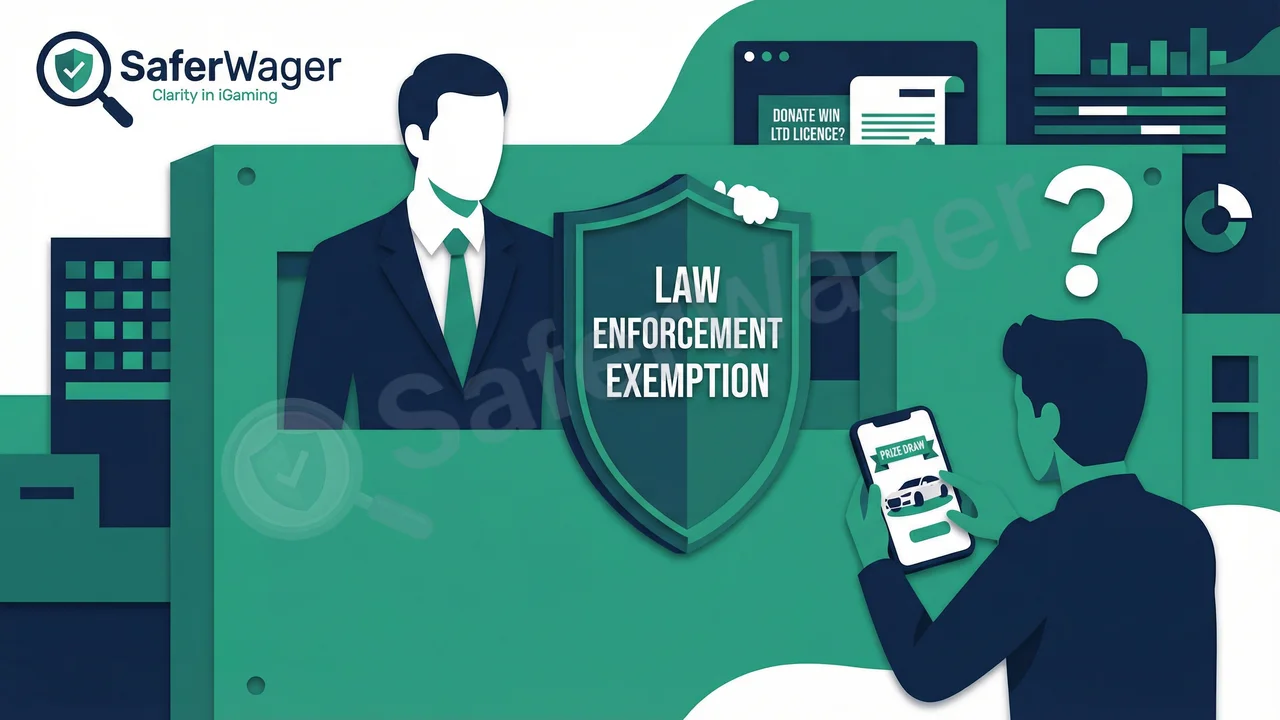
Instead of providing a direct answer, the Commission invoked Section 31(3) of the Freedom of Information Act 2000. This specific exemption, titled “Law Enforcement,” allows a public authority to refuse to confirm or deny whether it holds information if doing so would be likely to prejudice its law enforcement functions.
In its justification, the UKGC stated that confirming or denying the existence of information could:
- Alert individuals to a potential investigation (or lack thereof), allowing them to “alter their behaviours or evade detection.”
- Impact the willingness of stakeholders to share sensitive information with the Commission.
- Prejudice the outcome of any future investigation.
The Commission concluded that the public interest in protecting the integrity of its regulatory activities outweighed the public interest in transparency in this case.
Prize Competitions vs. Lotteries
The UKGC’s response also provided general context on the type of activity in question. It noted that such schemes are often categorised as “prize competitions and free draws” and are “free from regulation under the Gambling Act 2005.”
This is a crucial distinction. For an activity to be a prize competition and not a licensable lottery, it must either involve a significant element of skill or offer a genuine free entry route that is as prominent as the paid route. The UKGC’s statement implies that if Donate Win Ltd’s model meets these criteria, it would not require a gambling licence.
Significance for Consumers
A “neither confirm nor deny” response is a powerful tool used by regulators. While it does not confirm any wrongdoing, it prevents the public from knowing whether an operator is licensed, has been refused a licence, or is under investigation. This lack of clarity means consumers are left to make their own judgements about the operator's legitimacy.
The UKGC’s decision highlights the complex regulatory landscape surrounding prize draws and raffles. For consumers, it serves as a reminder that many popular prize draw websites operate outside the direct regulatory oversight of the Gambling Commission. The response encourages anyone with concerns about illegal or suspicious gambling activity to use the Commission's confidential “Tell us something in confidence” reporting service.