
UKGC Lacks Central Data on Scottish Track Licences
FOI response reveals premises licensing data is held by local authorities, not the national regulator.
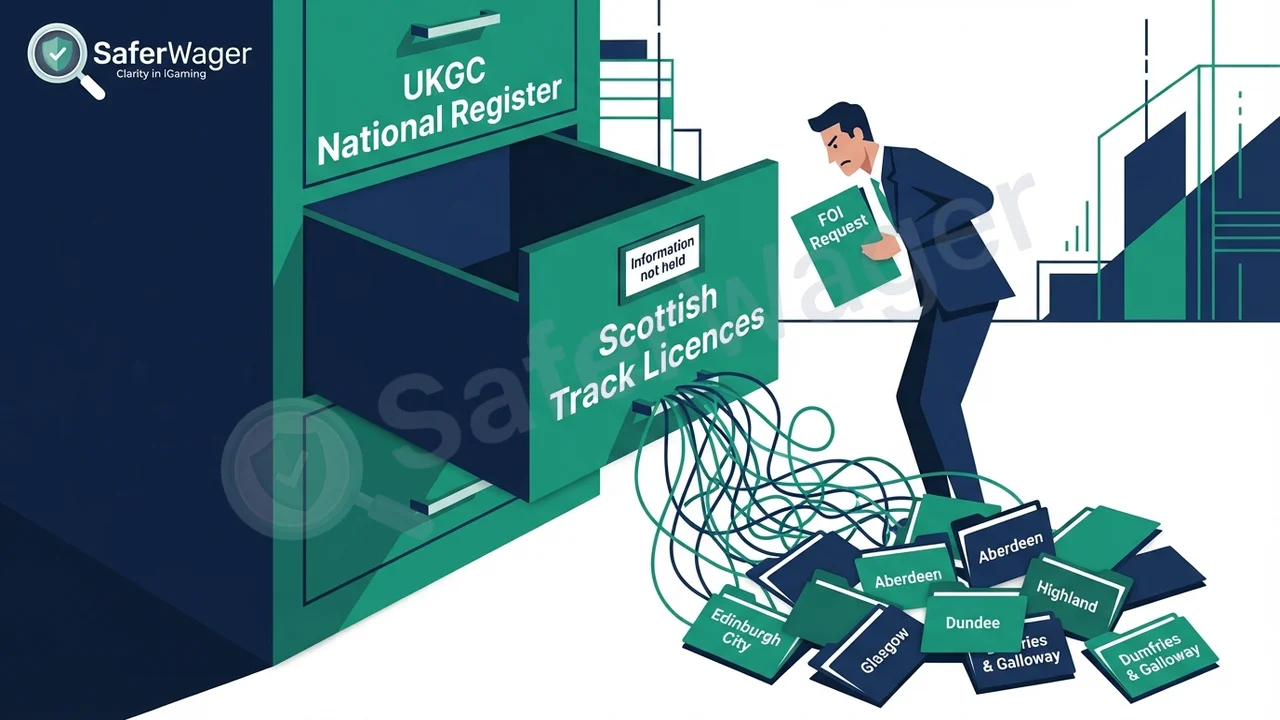
A Freedom of Information request has shown the UK Gambling Commission does not hold a definitive list of track-based gambling premises in Scotland. The regulator confirmed that this information is held by individual local authorities, highlighting a decentralised system for consumer information.
Article Content
Key Finding
A Freedom of Information (FOI) response from the UK Gambling Commission (UKGC) has revealed that the national regulator does not hold a definitive, central register of gambling licences for track premises in Scotland. Instead, this information is maintained by individual local authorities.
Context for Consumers
This disclosure is significant for consumers who wish to verify the licensing status of a gambling facility at a race track or other similar venue in Scotland. While the UKGC is the primary national regulator for gambling, this response clarifies that for physical premises, the most accurate and up-to-date information is held at a local level. It highlights a decentralised system that consumers should be aware of when seeking information or raising concerns about a specific venue.
Details of the FOI Request
The request, dated 28 December 2023, asked the UKGC for a complete list of all current licences granted in Scotland for track premises, including the business name, address, and the relevant local authority.
The Commission’s official response was "Information not held." In its explanation, the UKGC stated that premises licences—which authorise gambling in casinos, bingo halls, betting shops, and tracks—are issued by the local licensing authority responsible for that area.
While the UKGC does maintain a national register compiled from data provided by these authorities, it issued a crucial caveat. The Commission noted that this national database "may contain errors, duplications or there may be omissions." For this reason, the UKGC directed the requester to contact the relevant Local Authority directly for accurate and current premises information.
Significance and Implications
The response underscores the dual nature of gambling regulation in the UK. The UKGC is responsible for licensing operators, but the physical premises from which they operate are licensed by local councils. This means there is no single, guaranteed-accurate national database for the public to consult for all premises-related information.
For consumers, this means an extra step is required to confirm the legitimacy of a local gambling venue. Rather than relying on the UKGC's website, they must identify and contact the specific local council that governs the area where the premises are located.
This decentralisation of data can also pose challenges for researchers, journalists, and public health bodies attempting to create a national picture of gambling premises density and distribution. The lack of a single, verified central source necessitates collecting data from dozens of individual authorities, a time-consuming and complex process.