
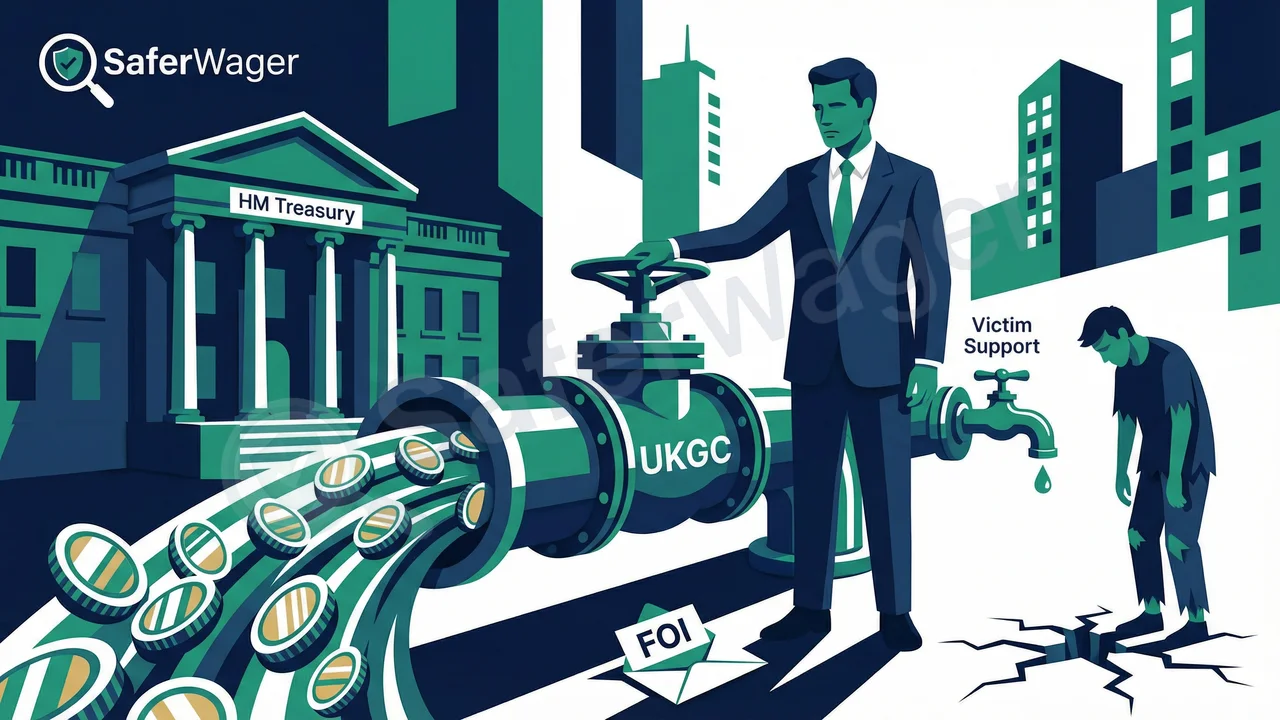
UKGC: Fines Go to Treasury, Not Victims
FOI reveals regulatory penalties are not used for direct victim compensation, while key financial data for 2022/23 remains unpublished.
A UK Gambling Commission FOI response confirms that fines paid by gambling operators go to the Treasury, not to victims of harm. The disclosure also revealed that 95 staff earn over £50,000, while key financial data for 2022/23 was withheld pending future publication.
Article Content
A Freedom of Information (FOI) disclosure has confirmed that financial penalties levied on gambling operators by the UK Gambling Commission (UKGC) are not used to directly compensate victims of gambling-related harm. Instead, the funds are transferred to HM Treasury.
The response, prompted by a request dated 5 August 2023, also revealed salary details for the regulator's senior staff but withheld key financial information for the 2022/23 financial year, citing a future publication schedule.
Where Do Regulatory Fines Go?
A key question for many consumers is what happens to the multi-million-pound fines issued to operators for regulatory breaches. The FOI request asked how much money from fines and penalties was given to victims in the last financial year.
The UKGC's response was unequivocal: "I can confirm that no recorded information is held falling within the scope of this part of your request."
The regulator clarified its process, stating: "The Gambling Commission only collect fines and pass the money across to the consolidated fund (Treasury) less our direct costs of collection."
This confirms that regulatory penalties serve a punitive purpose and contribute to general government funds, rather than acting as a direct redress mechanism for individuals who have suffered harm. While operators are sometimes required to make divestments to socially responsible causes as part of a regulatory settlement, the fines themselves are not ring-fenced for victim support.
Salary and Financial Transparency
The disclosure provided a snapshot of the Commission's staffing costs, revealing that for the last financial year:
- 95 full-time equivalent employees earned a wage of at least £50,000 per year.
- 7 of those employees earned a wage of at least £100,000 per year.
However, the UKGC declined to provide its total income from fines, licence fees, and any taxpayer funding for the 2022/23 financial year. The Commission invoked Section 22(1) of the FOIA, an exemption for information that is intended for future publication.
The regulator stated that this information would be published in its Annual Report and Accounts for 2022/23 "in due course." It argued that while there is a public interest in transparency, it was not cost-effective to release the data ahead of its planned publication schedule.
What This Means for Consumers
This FOI response provides crucial clarity on the function of regulatory fines. It underscores that the primary purpose of these penalties is to punish non-compliant operators and deter future breaches, with the proceeds benefiting the public purse via the Treasury. It also highlights a delay in the public availability of the regulator's complete financial accounts, with data for the year ending March 2023 still unpublished as of the request date in August 2023.
Consumers seeking compensation for losses due to operator failings typically must pursue this through an operator's internal complaints procedure, an approved Alternative Dispute Resolution (ADR) service, or legal action, as regulatory fines do not fund direct individual redress.