
UKGC Details BetIndex's Flawed Liquidity Defence
FOI response summarises how the collapsed operator justified a £100m liability gap to the regulator before its failure.
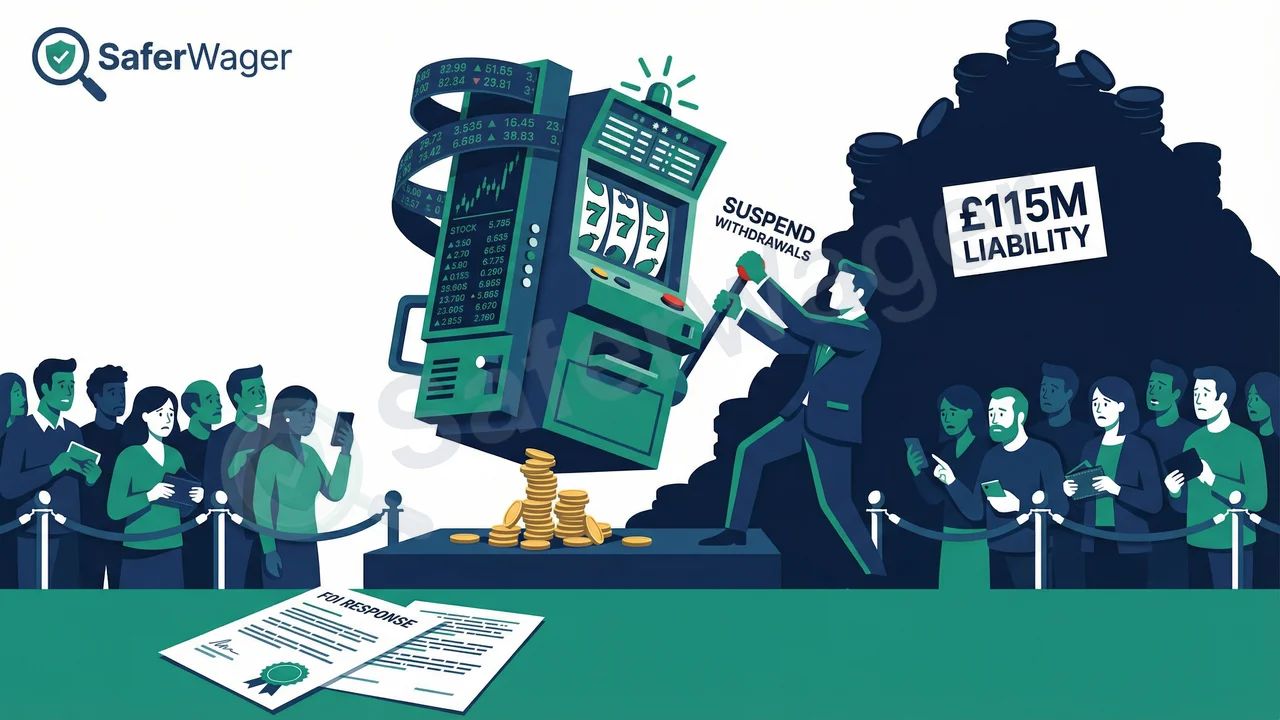
A Freedom of Information response from the Gambling Commission reveals the arguments BetIndex used to justify its financial position. The operator claimed it could suspend withdrawals and that its market would 'autocorrect' to cover a liability gap where only 15% of customer portfolio values were held in cash.
Article Content
A Freedom of Information (FOI) response from the Gambling Commission has shed new light on the arguments used by the collapsed operator BetIndex to justify its precarious financial position prior to its demise.
The response, published following a request dated 3 March 2025, summarises the evidence BetIndex (trading as Football Index) provided to the regulator to satisfy concerns over its liquidity. While the specific documents were withheld on the grounds they are accessible elsewhere, the Commission provided a detailed summary of the operator's defence.
A £100 Million Shortfall
The core issue identified by the regulator was a staggering liability gap. At one point, the total value of all customer 'shares' on the Football Index platform was £115 million. However, the Commission notes that BetIndex held only enough cash to cover 15 percent of this amount.
This created a significant risk for consumers. If a large number of customers attempted to cash out their portfolios simultaneously, the company would be unable to meet its obligations, leading to substantial consumer losses.
BetIndex's Justification
According to the UKGC's summary, BetIndex defended its position by arguing that the £115 million figure was not representative of its actual commercial risk. The operator claimed that the full value could never be realised simultaneously by all customers due to several platform mechanics:
- Transaction Limits: Limits were imposed on the number of 'shares' that could be sold in a single transaction.
- Algorithmic Price Changes: The platform's pricing algorithm would automatically decrease player 'share' prices to reflect falling demand.
- Right to Amend: BetIndex stated it had the ability to amend the pricing algorithm.
- Suspension of Withdrawals: The company reserved the right to suspend the 'Instant Sell' feature, either temporarily or permanently. BetIndex argued this was no different from the cash-out options offered by other betting operators.
Furthermore, the operator explained its belief that the market would never crash but would instead "autocorrect slowly over time based on supply/demand."
The 'Market Maker'
The FOI response also details the role of a 'Market Maker' operated by BetIndex itself on the platform. As of January 2020, this entity accounted for approximately 2.5 percent of all platform activity.
BetIndex explained its purpose was to provide 'liquidity' by buying bets in the 'Sell queue' and reintroducing them to the market. Crucially, the UKGC notes that this 'Market Maker' had access to non-public data, such as queue depths, and possessed the ability to change the platform's pricing algorithm—a significant advantage over ordinary consumers.
What This Means for Consumers
This disclosure provides a stark insight into the flawed business model of Football Index and the arguments presented to the regulator. It highlights the immense risk consumers were exposed to, where the platform's stability relied on the operator's ability to change the rules and suspend withdrawals.
The collapse of BetIndex in March 2021 left thousands of customers with significant financial losses and triggered an independent review of the Gambling Commission's regulation of the company. This FOI summary serves as a critical case study on the dangers of novel gambling products and the importance of regulatory scrutiny over an operator's liquidity and internal market mechanics.