
UKGC financial penalties: direct enforcement and how penalty amounts are determined
A UKGC financial penalty is a direct sanction imposed on a licensed operator following a concluded enforcement process that found breaches of LCCP licence conditions. This page covers direct financial penalties. Regulatory settlements under Section 117 of the Gambling Act 2005 are a distinct mechanism covered separately.
Filter by Action Type
Financial Penalties List

A Cash Limited
Financial PenaltyFollowing an investigation, the Gambling Commission found that A Cash Limited breached Licence condition 15.3.1 related to general and regulatory returns. As a result, the Commission imposed a fina...

Mark Stuart Lloyd
Financial PenaltyFollowing a review, the Commission found that Mark Stuart Lloyd (t/a East Midlands Vending Supplies) failed to comply with Licence Condition 15.3.1. As a result, the Commission imposed a financial ...

AliQuantum Gaming Limited
Financial PenaltyFollowing an investigation, the Gambling Commission found that AliQuantum Gaming Limited breached Licence condition 15.3.1 concerning general and regulatory returns. Consequently, the Commission im...

Tombola (International) Plc
Financial PenaltyFollowing an investigation, Tombola (International) Plc was found to have breached Social Responsibility Code Provisions related to direct electronic consent and self-exclusion. The Gambling Commis...

Grace Media (Gibraltar) Limited
Financial PenaltyGrace Media (Gibraltar) Limited breached social responsibility codes related to self-exclusion (SRCP 3.5.3) and direct electronic marketing consent (SRCP 5.1.11). The Gambling Commission imposed a ...

John Hughes Bookmakers Limited
Financial PenaltyFollowing an investigation, the Gambling Commission found that John Hughes Bookmakers Limited breached Licence condition 15.3.1 concerning general and regulatory returns. As a result, the Commissio...
Gary Boyle
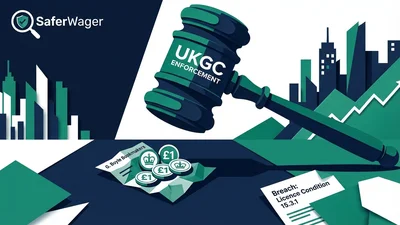
Financial PenaltyFollowing an investigation outside of a licence review, the Gambling Commission found that Gary Boyle breached Licence condition 15.3.1 related to general and regulatory returns. As a result, the C...
Oasis Amusements Hemsby Limited
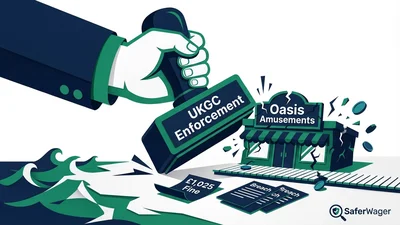
Financial PenaltyFollowing an investigation, the Gambling Commission found that Oasis Amusements Hemsby Limited breached Licence condition 15.3.1 concerning general and regulatory returns. The same breach was repea...

Sandancer Leisure Limited
Financial PenaltyFollowing an investigation, the Gambling Commission found that Sandancer Leisure Limited breached Licence condition 15.3.1 regarding general and regulatory returns. As a result, the Commission impo...

Petfre (Gibraltar) Limited
Financial PenaltyFollowing an investigation, Petfre (Gibraltar) Limited was found to have breached licence condition 2.3.1 regarding technical standards. The Commission imposed a financial penalty of £240,000, not...

ProgressPlay Limited
Financial PenaltyProgressPlay Limited was found to have breached anti-money laundering (AML) and social responsibility code provisions. As a result, the Commission imposed a £1,000,000 financial penalty, issued a ...

Spreadex Limited
Financial PenaltySpreadex Limited was found to have breached anti-money laundering and social responsibility code provisions between September 2022 and November 2023. Consequently, the Commission imposed a £2,022,...

Lee Walker
Financial PenaltyFollowing an investigation, the Gambling Commission found that Lee Walker breached Licence condition 15.3.1 regarding general and regulatory returns. As a result, the Commission imposed a financial...

Fun City (UK) Limited
Financial PenaltyFollowing an investigation, the Gambling Commission found that Fun City (UK) Limited breached Licence condition 15.3.1 regarding general and regulatory returns. As a result, the Commission imposed ...
Taichi Tech Limited
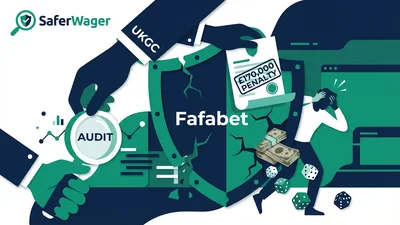
Financial PenaltyFollowing a review, Taichi Tech Limited was found to have breached licence conditions related to fair terms, anti-money laundering, social responsibility, and marketing. The Commission imposed a £...

Bingo Lingo Limited
Financial PenaltyFollowing an investigation, the Gambling Commission found that Bingo Lingo Limited breached Licence condition 15.3.1 for failing to submit general and regulatory returns. The Commission imposed a f...

J&E Slots Unlimited
Financial PenaltyFollowing an investigation, the Gambling Commission found that J&E Slots Unlimited breached Licence condition 15.3.1 regarding the submission of general and regulatory returns. The Commission impos...

Robert Waterhouse
Financial PenaltyFollowing an investigation, the Gambling Commission found that Robert Waterhouse breached Licence condition 15.3.1 concerning general and regulatory returns. Consequently, the Commission imposed a ...

Corbett Bookmakers Limited
Financial PenaltyCorbett Bookmakers Limited was found to have breached anti-money laundering (Licence Condition 12.1.1) and social responsibility (code 3.4.1) regulations. Consequently, the Commission imposed a fin...

Norwich City Football Club
Financial PenaltyFollowing an investigation, the Gambling Commission found that Norwich City Football Club breached Licence condition 15.3.1 for failing to submit regulatory returns on time. The Commission imposed ...
What a UKGC financial penalty is and how it differs from a regulatory settlement
The UKGC has two primary monetary enforcement mechanisms. A direct financial penalty is imposed by the Commission after a formal enforcement process in which the UKGC concludes that the operator breached its licence conditions. A regulatory settlement under Section 117 of the Gambling Act 2005 is an agreed outcome where the operator and the UKGC reach terms before a formal finding is made.
These are not the same thing, and they don't carry the same regulatory implications. A direct financial penalty means the UKGC has concluded that breaches occurred and has exercised its statutory power to penalise the operator. A settlement means the operator agreed to remediation and a payment without that formal conclusion being reached.
The statutory basis for UKGC financial penalties
The UKGC's power to impose financial penalties comes from the Gambling Act 2005, specifically the provisions covering licence reviews and sanctions. Where a licence review concludes that an operator has breached its licence conditions or codes of practice, the Commission can impose a financial penalty up to a statutory maximum, suspend or revoke the licence, or attach conditions to it. A financial penalty can be imposed alongside other sanctions rather than instead of them.
The process is formal. The UKGC issues a notice of intent, the operator has an opportunity to make representations, and the Commission then issues a final decision. That decision document is typically published, which is why direct financial penalty cases generate public enforcement records. The published document confirms the breaches found and the penalty amount.
Why Section 117 settlements are a different category
A Section 117 regulatory settlement is reached before the formal penalty process concludes. The operator agrees to make a payment in lieu of a financial penalty, usually alongside commitments to remediate the identified failings. The UKGC doesn't make a formal finding of breach in a settlement. That distinction matters: a settlement record shows the UKGC identified concerns serious enough to open a review, but the operator resolved those concerns without a concluded finding against it.
Why this distinction matters in enforcement analysis: News coverage often treats UKGC regulatory settlements and direct financial penalties interchangeably, referring to both as 'fines'. They aren't. A direct financial penalty follows a concluded enforcement process with formal findings. A settlement is an agreed resolution. Reading the original UKGC enforcement document rather than secondary coverage is the only reliable way to identify which mechanism applies in a specific case. Saferwager's enforcement index notes the mechanism type on each record.
How UKGC penalty amounts are determined
The UKGC doesn't publish a formula for calculating financial penalty amounts. There's no stated table converting breach severity to a specific figure. But the Commission's enforcement decisions consistently refer to a set of factors it considers when deciding on the penalty amount, and patterns across published decisions allow those factors to be identified.
The absence of a published formula isn't unusual among UK regulators. The Financial Conduct Authority and the Information Commissioner's Office both operate discretionary penalty frameworks. The UKGC's approach is consistent with that regulatory model.
The factors the UKGC considers when setting a penalty
Published enforcement decisions reference operator size and turnover as relevant to penalty calculation. A penalty that would represent a material financial consequence for a small operator may be trivial relative to the annual revenue of a large group. The UKGC has stated that it intends penalties to be effective as a deterrent, which requires that they're calibrated to the operator's economic circumstances.
Duration of the breach matters. A systemic failure that persisted across several years weighs more heavily than a single-instance breach that the operator identified and corrected quickly. The UKGC's published decisions distinguish between operators that identified and self-reported failings versus those where the UKGC's own review identified issues the operator hadn't flagged.
Cooperation, self-reporting, and mitigation in penalty decisions
Operators that cooperate fully with UKGC investigations and demonstrate genuine remediation consistently receive credit in penalty determinations. Cooperation doesn't eliminate the penalty, but published decisions show it influences the final amount. Self-reporting a compliance failure before the UKGC identifies it independently is treated as a more significant mitigating factor than cooperation after the regulator has already opened a review.
Demonstrated consumer harm is an aggravating factor. Where the UKGC finds evidence that specific consumers suffered because of the operator's failures, including cases where customers in financial difficulty continued to be allowed to gamble without interaction, the penalty reflects that outcome. The breach being technical versus harm having been demonstrated produces different outcomes in published decisions.
What penalty amounts alone don't convey
- Headline penalty amount
- The stated financial penalty in a UKGC enforcement decision. Covers the statutory penalty element only. Does not include divested revenue from player harm, which is separately directed in many decisions.
- Divested revenue
- Money the operator is required to pay that represents revenue generated during the period of non-compliance. Treated separately from the penalty amount in UKGC enforcement decisions. Often larger than the penalty itself in major cases.
- Licence conditions imposed
- Additional conditions attached to the operator's licence as part of the enforcement outcome. These can require independent audits, enhanced reporting, or specific remediation steps. They're part of the enforcement outcome but don't show in penalty amount figures.
- Directed audit requirement
- A requirement for the operator to commission an independent compliance audit, the results of which must be submitted to the UKGC. Common in major enforcement cases. Represents a continuing obligation beyond the payment of the penalty.
Common violation categories leading to UKGC financial penalties
Published UKGC enforcement decisions identify two categories of breach as most common in cases that result in direct financial penalties: anti-money laundering failures and social responsibility failures. These categories appear consistently across the enforcement record, though individual decisions vary significantly in what specific conduct the UKGC identified as non-compliant.
Neither category is a single condition. AML failings can range from inadequate customer due diligence processes to absence of source-of-funds checks on high-spending customers. Social responsibility failures cover a wide range of conduct from missing interaction triggers to allowing self-excluded customers to open new accounts.
Anti-money laundering condition breaches
UKGC licence conditions require operators to implement anti-money laundering programmes that are proportionate to the risks their business faces. The relevant LCCP conditions under ordinary code provision 2 set out what an AML programme must include: risk assessment, customer due diligence, source-of-funds assessment for customers depositing or losing at significant levels, and transaction monitoring.
Published enforcement cases show AML failures clustering around operators that failed to apply timely source-of-funds checks when customer spending or loss patterns triggered their own risk thresholds. Cases have also involved inadequate record-keeping, failure to update customer risk assessments when new information became available, and reliance on customer self-declaration rather than verification of financial capacity.
Social responsibility condition breaches
Social responsibility conditions under LCCP SR Code 3.4.1 require operators to interact with customers whose behaviour suggests they may be experiencing gambling harm. Published enforcement decisions have found operators failed to act on clear indicators: customers spending at levels inconsistent with their income, customers who had previously self-excluded or set deposit limits then being allowed to escalate their spending without interaction, and customers explicitly indicating distress who continued to receive marketing communications.
The most serious cases involve patterns sustained over months or years. The UKGC's enforcement decisions in these cases are explicit about the gap between what the operator's own policies said it would do and what it actually did.
How breach categories interact in enforcement decisions
- AML and social responsibility failures often appear together in major enforcement decisions. The same customer who should have triggered source-of-funds checks often showed harm indicators that should have triggered a social responsibility interaction. Operators that failed one set of conditions frequently failed the other in the same period.
- Technical and procedural failures appear less frequently as the primary driver of large financial penalties, but they contribute to cases where the main breach is AML or social responsibility. An operator whose systems couldn't generate the data needed for effective monitoring has a structural problem that compounds the conduct failures.
- Advertising and marketing conditions under the CAP and BCAP codes, enforced through the ASA and separately through UKGC licence conditions, appear in some enforcement cases but rarely as the sole basis for a large financial penalty.
- Licence condition 1 failures relating to business conduct and the requirement to act in accordance with the licensing objectives appear in major cases, particularly where the UKGC concludes the operator's failings reflected a systemic rather than incidental approach to compliance.
How financial penalties feed into Saferwager's Trust Scores
A UKGC financial penalty is the most significant single event that affects an operator's enforcement sub-score within the Trust Score. The severity weighting system assigns higher weight to financial penalties than to advisory findings or minor procedural cautions. But the final impact on the Trust Score depends on how the penalty is classified on the severity scale and how recently it occurred.
A large financial penalty imposed for systemic AML and social responsibility failures over a sustained period carries a different severity rating than a smaller penalty for a narrower technical breach. The headline penalty amount is one input. The nature of the breach, the duration of the failures, and whether consumer harm was demonstrated all affect where on the 1-to-5 severity scale Saferwager classifies the action.
Why penalty size and regulatory significance aren't always the same
A £1 million fine imposed on an operator generating £500 million in annual gross gambling yield is a materially different outcome from a £1 million fine imposed on an operator generating £20 million in GGY. The headline amount is the same. The regulatory significance, measured by what the penalty represents relative to the operator's economic circumstances, is completely different.
Saferwager's enforcement severity rating accounts for this. A large absolute penalty against a very large operator scores differently from the same absolute penalty against a small operator. The purpose is to reflect what the regulatory record actually says about conduct, not just what number appears in the press release.
Recency weighting and how financial penalties decay in the enforcement sub-score
Enforcement sub-scores use recency weighting. A financial penalty imposed several years ago and not followed by further enforcement activity decays in its impact over time. An operator that received a significant penalty but has maintained a clean record since is in a different position from one that received the same penalty recently or has had repeated enforcement actions.
Recency weighting doesn't erase historical penalties. They remain in the enforcement index and remain linked to the operator profile. But their weight in the composite Trust Score decreases as time passes without further enforcement activity.
Enforcement records as a component of operator profiles
| Enforcement data point | Where it appears | How it affects Trust Score |
|---|---|---|
| Direct financial penalty | Enforcement index, operator profile enforcement tab | High weight in enforcement sub-score, severity-rated 1-5, recency-weighted |
| Section 117 regulatory settlement | Enforcement index (separate category), operator profile | Moderate weight, lower than direct penalty, reflects concern without formal finding |
| Licence conditions imposed | Operator profile notes where identifiable | Feeds into licence sub-score where conditions materially restrict operations |
| Audit requirements | Noted in enforcement records where stated in UKGC decision | Indirect signal in transparency sub-score where post-audit compliance is documented |